
Overview
What are Sports Injuries?
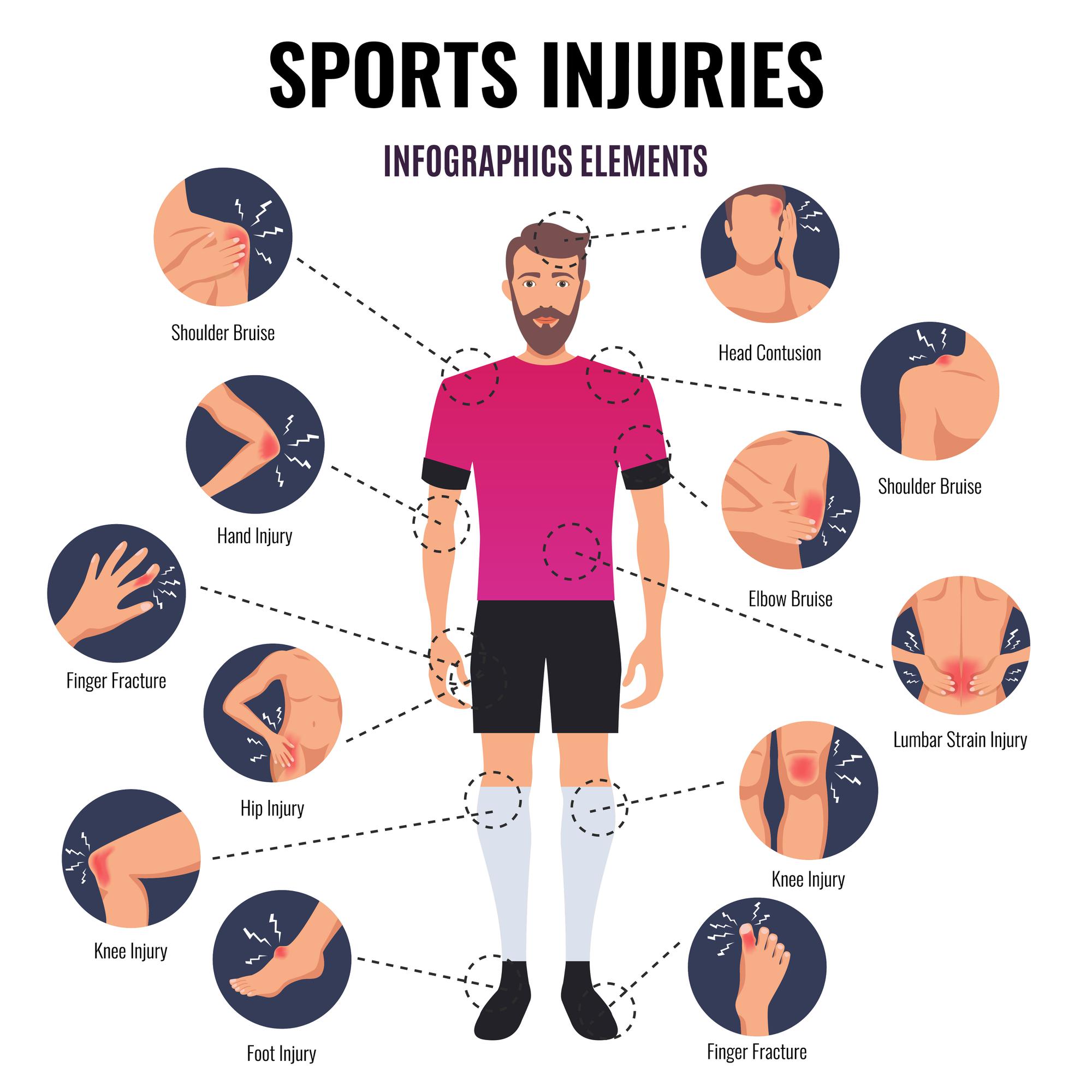
Sports injuries are musculoskeletal injuries affecting the muscles, tendons, ligaments, joints or bones as a result of physical activity. They affect everyone from elite athletes to weekend runners and gym-goers, and they range from minor niggles to injuries that keep you out of sport for weeks or months. A sports injury is a broad category rather than a single diagnosis, and identifying the specific injury — and why it happened — is central to both recovery and preventing recurrence.
Sports injuries fall into two main groups. Acute injuries happen suddenly, through a specific event — a twist, impact, fall or sudden movement — and include sprains, strains, contusions, dislocations and fractures. Overuse (chronic) injuries develop gradually when a tissue is loaded repeatedly faster than it can adapt and recover, and include tendinopathies, stress fractures and a range of “-itis”-type conditions. Recognising which type you have matters, because acute injuries are managed differently from overuse injuries.
Two distinctions are worth understanding. A sprain is an injury to a ligament (which connects bone to bone), whereas a strain is an injury to a muscle or tendon — the two terms are often confused but describe different tissues. Both are commonly graded by severity, from Grade I (mild overstretch) to Grade III (a complete tear).
A key modern principle is load management: most overuse injuries stem not from a single event but from doing “too much, too soon” — a rapid increase in training volume, intensity or frequency without enough recovery. Understanding and managing load is often the difference between recovering fully and repeatedly re-injuring.
In Singapore’s increasingly active population — with a strong running, gym and recreational-sport culture — sports injuries are common across all ages and abilities.
Sports injuries are described by:
- Onset: Acute (sudden) or overuse (gradual)
- Tissue: Ligament (sprain), muscle/tendon (strain), joint, or bone
- Severity: Commonly graded from Grade I (mild) to Grade III (severe/complete tear)
This helps determine the safest and most effective management and return-to-sport plan.
Know your pain
Types of Sports Injuries & Related Conditions
Sports injuries take many forms depending on the tissue involved and how the injury occurred.
Sprains (Ligament Injuries)
Overstretching or tearing of a ligament — the ankle sprain is the single most common sports injury, while knee ligament injuries (such as the ACL and MCL) are common in twisting and contact sports.
Strains (Muscle & Tendon Injuries)
Overstretching or tearing of a muscle or tendon — hamstring, calf and groin strains are especially common in running and sprinting sports.
Tendinopathies (Overuse)
Gradual tendon breakdown from repetitive load, such as Achilles tendinopathy, patellar tendinopathy (jumper's knee), rotator cuff tendinopathy and tennis or golfer's elbow.
Stress-Related Bone Injuries
Stress fractures and shin splints (medial tibial stress syndrome) from repetitive impact, common in runners.
Joint & Cartilage Injuries
Including meniscus tears, cartilage injuries and joint irritation.
Contusions, Dislocations & Fractures
From direct impacts and falls, particularly in contact and high-speed sports (these often need medical assessment).
Concussion
A brain injury that can occur in contact sport — it is not a musculoskeletal injury and requires medical assessment and specific concussion management.
Other Overuse Conditions
Iliotibial (IT) band syndrome, patellofemoral pain (runner's knee), plantar fasciitis, bursitis and shoulder impingement.
The science
How the Body's Structures Are Affected?
Sport loads the whole musculoskeletal system, and injuries reflect where and how that load exceeds a tissue’s capacity.
Muscles & Tendons:
Powerful, repeated contractions and stretches can strain muscles or gradually break down tendons, producing strains and tendinopathies.
Ligaments & Joints:
Twisting, impact and instability can sprain or tear the ligaments that stabilise joints, particularly the ankle and knee.
Bone:
Repetitive impact without adequate recovery can lead to stress reactions and stress fractures.
The Kinetic Chain & Biomechanics:
Crucially, injuries are often influenced by how the whole body moves. Muscle imbalances, poor movement patterns, or issues elsewhere in the kinetic chain (for example, hip weakness contributing to knee injury, or poor foot mechanics affecting the lower limb) frequently underlie both acute and overuse injuries — which is why effective care looks beyond the injured tissue to the movement behind it.
Why it happens
Common Causes of Sports Injuries
Sports injuries usually result from a combination of factors rather than bad luck alone.
Training error & overload
The leading cause of overuse injury — increasing training volume, intensity or frequency too quickly, without enough recovery.
Poor technique & biomechanics
Inefficient movement patterns and muscle imbalances place abnormal load on specific tissues.
Inadequate warm-up or preparation
Going hard without preparing the body raises injury risk.
Muscle weakness & imbalance
Weak or imbalanced muscles reduce control and load tolerance.
Previous injury
A past injury, especially if not fully rehabilitated, is one of the strongest predictors of a new one.
Fatigue, equipment & environment
Tiredness, unsuitable footwear or equipment, and playing surfaces can all contribute.
Contributing factors
Rapid increases in training load · poor technique and biomechanics · muscle weakness or imbalance · inadequate warm-up · previous incompletely rehabilitated injury · fatigue and overtraining · unsuitable footwear or equipment.
Recognising it
Signs & Symptoms of Sports Injuries
Symptoms depend on whether the injury is acute or overuse, and on the tissue involved.
- Sudden pain during activity with an acute injury, sometimes with a “pop” or snap.
- Swelling and bruising, particularly with sprains, strains and contusions.
- Reduced range of motion and stiffness.
- Weakness or difficulty bearing weight or loading the limb.
- Joint instability or “giving way” with ligament injuries.
- Gradually worsening pain with activity in overuse injuries, often easing with rest early on but becoming more persistent over time.
- Tenderness over the affected tendon, muscle, ligament or bone.
⚠ Warning signs — when to seek urgent care
- An inability to bear weight or use the limb, or a suspected fracture.
- An obvious deformity or dislocation
- Severe swelling or a joint that feels unstable (possible complete ligament rupture)
- Severe or rapidly worsening pain
- Numbness, tingling or loss of circulation
- Any head injury with signs of concussion (confusion, dizziness, headache, nausea, memory problems, loss of consciousness).
Getting help
When Should You See a Chiropractor for a Sports Injury?
Many sports injuries respond well to conservative care that treats both the injury and the movement behind it. Consider an assessment if you have:
- An acute injury such as a sprain or strain that needs proper assessment and a recovery plan.
- A persistent or recurring overuse injury that isn’t settling with rest.
- Pain that limits your training or performance.
- A previous injury you want to rehabilitate fully to reduce re-injury risk.
- Recurring injuries that suggest an underlying biomechanical cause.
Any red-flag symptoms above need medical assessment first. Part of our role is recognising injuries that need imaging, specialist or surgical care — such as fractures, complete ruptures or suspected concussion — and referring promptly.
Your first step
How Do We Diagnose a Sports Injury?
A careful assessment identifies the injured tissue, its severity, and the movement factors behind it — and screens for injuries that need medical attention.
History & mechanism review
We discuss how the injury happened (or how symptoms developed), your sport and training, and your goals — the mechanism often points straight to the diagnosis.
Physical examination
We assess range of motion, strength, joint stability, swelling and areas of tenderness, and grade the injury where relevant.
Special orthopaedic tests
Targeted tests for the specific joint or tissue help confirm the diagnosis and severity.
Biomechanical & movement assessment
We evaluate movement patterns, muscle balance and the kinetic chain to identify contributing factors — a key step in preventing recurrence.
Imaging & referral when necessary
Many sports injuries are diagnosed clinically. If a fracture, complete ligament tear, or another condition needing specialist care is suspected, we refer for imaging (X-ray, ultrasound, MRI) or specialist review.
How we help
Sports Injury Care Options at Agape Chiropractic Clinic
Effective sports-injury care combines settling the injury, restoring function, and correcting the factors behind it so you can return to sport safely and reduce the risk of recurrence. Depending on your injury, your plan may include one or more of the following.
Acute injury management
Modern early management follows protection and optimal loading principles (the POLICE approach — Protection, Optimal Loading, Ice, Compression, Elevation — and the more recent PEACE & LOVE framework) rather than prolonged rest, since appropriate early loading supports better healing.
Soft tissue therapy
Myofascial release, trigger point therapy, Active Release and instrument-assisted techniques (IASTM) for injured and tight muscles and tendons to reduce tension and support recovery.
Chiropractic adjustments & mobilisation
Techniques to restore movement to restricted joints — including addressing the kinetic chain, not just the injured area — to support better mechanics.
Shockwave therapy
Focused acoustic-wave therapy for stubborn tendon-related sports injuries such as Achilles, patellar and elbow tendinopathies, as part of a broader plan.
Progressive rehabilitation & return-to-sport
Graded strengthening, mobility and sport-specific loading to rebuild capacity and guide a safe, staged return to activity — the cornerstone of lasting recovery.
Biomechanical correction & prevention
Addressing muscle imbalances, movement patterns and technique, plus taping, bracing and footwear advice where helpful, to reduce re-injury risk.
Your journey
What to Expect During Your Sports Injury Care?
Initial consultation
A detailed discussion of how the injury happened, your sport and training, and your return-to-activity goals.
Comprehensive assessment
A thorough examination of the injured area plus your movement, strength and biomechanics.
Personalised care plan
We explain our findings, discuss your diagnosis and grade, and recommend a plan combining hands-on care, shockwave therapy where appropriate, and progressive rehabilitation.
Monitoring your progress
We track your recovery, progress your loading, and guide a staged return to training and competition.
Timelines
Recovery & Return to Sport
Recovery time depends heavily on the injury and its severity — a mild strain or sprain may settle in a couple of weeks, while more significant injuries and stubborn tendinopathies take longer. The goal isn’t just to be pain-free but to restore full strength, control and confidence before returning to sport, because returning too early is a leading cause of re-injury.
Factors that influence recovery: the type and severity (grade) of injury · whether it’s acute or overuse · which tissue is involved · your overall fitness and health · whether contributing biomechanical factors are addressed · and how consistently you complete your rehabilitation and follow a graded return-to-sport plan.
Because so many sports injuries relate to load and movement, rebuilding capacity progressively and correcting the underlying factors — rather than simply resting until the pain goes — is what produces a durable return and lowers re-injury risk.
Self-care
Managing Sports Injuries at Home
Sensible early self-care supports recovery. Seek professional assessment for anything beyond a minor injury — and urgent care for any red-flag symptom.
- Protect and load appropriately. For acute injuries, protect the area early but return to gentle, pain-guided movement rather than complete rest, in line with modern POLICE / PEACE & LOVE principles.
- Manage swelling with compression, elevation and (for comfort) ice in the early stage.
- Avoid returning to full activity too soon — a common cause of re-injury.
- Follow your rehabilitation programme, progressing load gradually.
- Address training errors — build volume and intensity gradually.
- Know when to seek care if you can’t bear weight, the joint is unstable, there’s significant swelling or deformity, or after any head knock.
Staying well
How to Prevent Sports Injuries?
- Manage your training load — increase volume and intensity gradually and allow recovery.
- Warm up properly and include mobility before activity.
- Build strength and conditioning, correcting muscle imbalances.
- Work on technique and movement quality.
- Fully rehabilitate previous injuries before returning to sport.
- Use suitable footwear and equipment, and respect fatigue and recovery.
Tailored care
Sports Injuries Across Different Sports & Lifestyles
Runners
Prone to overuse injuries such as shin splints, IT band syndrome, patellofemoral pain, Achilles tendinopathy and stress fractures.
Gym & strength athletes
More likely to sustain muscle strains, tendinopathies and joint overload.
Racket-sport players
Common tennis/golfer's elbow, shoulder and lower-limb injuries.
Contact & team-sport athletes
Higher rates of acute sprains, strains, contusions and, importantly, concussion (which needs medical care).
Older active adults
May recover more slowly and benefit from careful load management and conditioning.
Weekend warriors
Sudden bursts of activity without conditioning increase acute-injury risk.
About us
Why choose Agape Chiropractic Clinic?
Our Chiropractic Clinic in Orchard focuses on getting to the root of your pain, not just easing symptoms for a day. We combine careful diagnosis with a range of techniques so your care fits your condition, and we’re upfront about what chiropractic can and can’t help — including when to refer you elsewhere.
Dr. Luke Ho
Dr. Luke Ho obtained his Chiropractic degree from Palmer College of Chiropractic, Davenport, Iowa, USA in 2005. Prior to graduating, he worked in the campus clinic for 18 months as a clinical extern, treating students, faculty, and outpatients. In 2001 Dr. Ho obtained a BSc. in Sports Medicine from the University of Evansville, Indiana, USA. During his 3rd and 4th years there, he interned at the St. Mary’s Hospital Cardiac Rehabilitation Department, the St. Mary’s Sports and Fitness Center, and the University of Evansville Rehabilitation Center where he worked closely with the university tennis, volleyball, basketball and baseball teams.
Questions