
Overview
What is a Slipped / Herniated Disc?
A herniated disc — also called a slipped disc, prolapsed disc or ruptured disc — occurs when the soft inner material of an intervertebral disc pushes out through a weakened area in its tough outer layer, sometimes irritating or compressing a nearby spinal nerve. It is one of the most common structural causes of back, neck and radiating limb pain, and it is a specific condition rather than a general symptom.
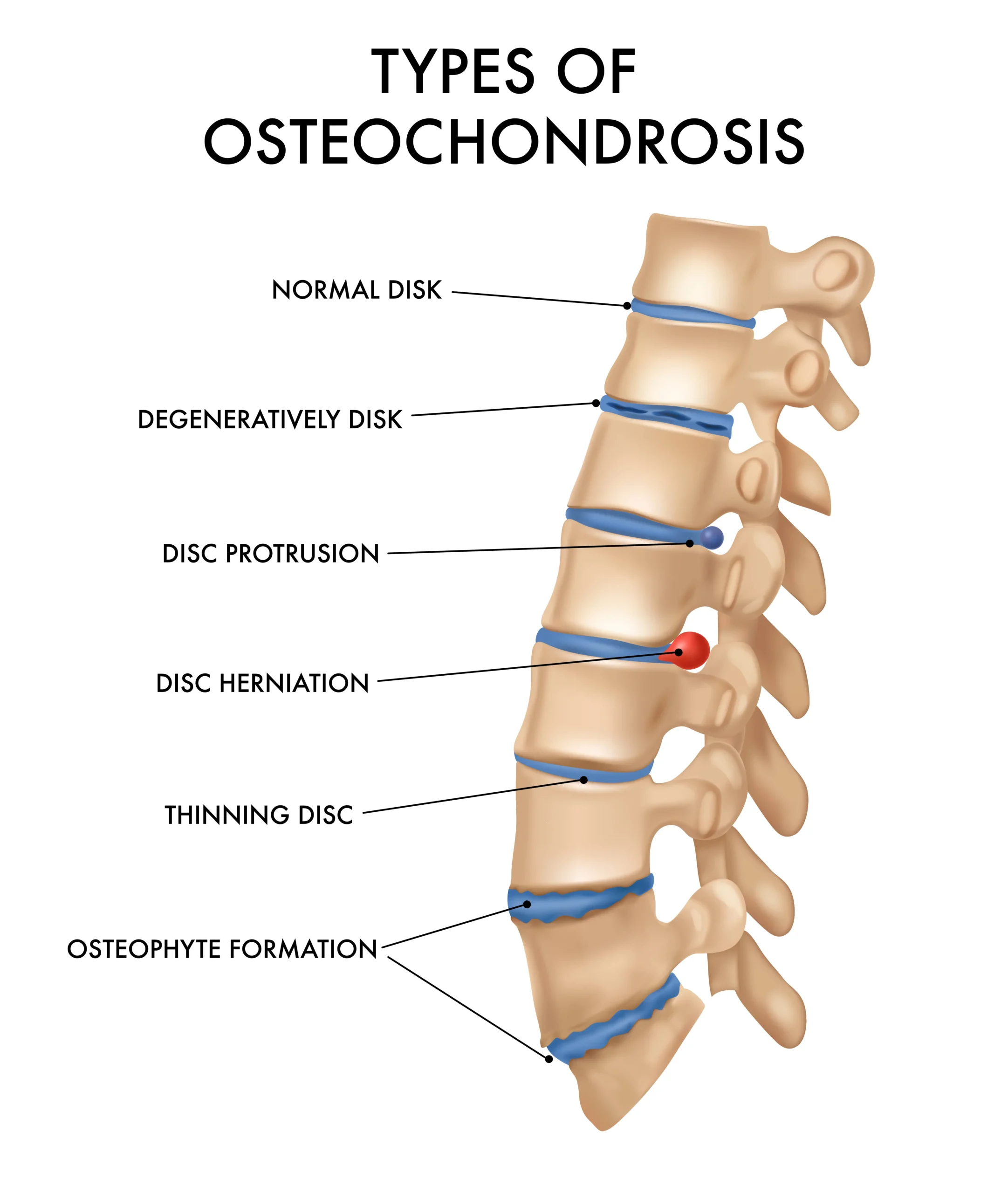
The term “slipped disc” is actually a misnomer — the disc doesn’t slip out of place. Each intervertebral disc sits firmly attached between two vertebrae and is made of two parts: a soft, gel-like centre called the nucleus pulposus, and a tough outer ring called the annulus fibrosus. When the annulus weakens or tears, the nucleus can bulge or herniate outward. If this herniation presses on a nearby nerve root, it produces the radiating symptoms sciatica in the leg (from a lumbar disc) or arm symptoms (from a cervical disc) — that many people associate with a “slipped disc.”
Disc herniations most commonly occur in the lower back, particularly at the L4–L5 and L5–S1 levels, and in the neck at C5–C6 and C6–C7. Lumbar disc herniation is the leading cause of sciatica .
An important and often surprising point: disc bulges and herniations are frequently found in people with no pain at all. Imaging studies show that disc changes are common in symptom-free adults — increasing with age — which means a disc finding on a scan does not automatically explain someone’s pain. This is why diagnosis relies on the clinical picture as a whole, not on imaging alone.
In Singapore, disc-related back and neck pain is common among a desk-bound, sedentary population as well as those doing heavy or repetitive lifting.
Clinically, a herniated disc is described by duration:
- Acute: Less than 6 weeks
- Subacute: 6 to 12 weeks
- Chronic: More than 3 months
This classification, together with the symptom pattern and examination, helps determine the most appropriate management plan.
Know your pain
Types of Disc Herniation & Related Conditions
Disc problems are described by how far the disc material has displaced and where the herniation occurs.
Disc Bulge
The disc extends slightly beyond its normal boundary, often broadly, without the inner material breaking through — a common and frequently painless finding.
Disc Protrusion
The nucleus pushes against a weakened annulus, causing a more focal outward bulge while the outer ring remains largely intact.
Disc Extrusion
The inner nucleus material breaks through the annulus but remains connected to the disc.
Disc Sequestration
A fragment of the nucleus separates completely and moves into the spinal canal — interestingly, these larger, non-contained herniations are often the most likely to shrink on their own over time.
By location
Lumbar (lower back — the most common, causing back pain and sciatica), cervical (neck — causing neck and arm symptoms), and thoracic (mid-back — rare).
Related conditions
sciatica (leg symptoms from a lumbar disc), cervical radiculopathy (arm symptoms from a neck disc), degenerative disc disease, and spinal stenosis, which can coexist with disc problems.
The science
How Spinal Structures Affect a Herniated Disc?
The spine relies on healthy discs to cushion the vertebrae, absorb load and allow movement. Understanding the disc’s structure explains how and why herniations cause symptoms.
The Intervertebral Disc
Each disc acts as a shock absorber between two vertebrae, made of the gel-like nucleus pulposus surrounded by the fibrous annulus fibrosus.
The Nucleus & Annulus
When the annulus weakens — through age, load or injury — the nucleus can push outward. A tear in the annulus is what allows a herniation to occur.
The Nerve Roots
Spinal nerve roots exit beside each disc. A herniation that presses on or chemically irritates a nerve root produces radiating pain, numbness, tingling or weakness along that nerve’s path.
Level & Symptom Mapping
Which nerve is affected determines where symptoms are felt — for example, an L5–S1 herniation typically refers pain down the back of the leg, while a C6–C7 herniation affects the arm and hand. This mapping helps localise the problem clinically.
The Spinal Canal & Cauda Equina
A very large herniation can compress multiple nerves or the cauda equina (the bundle of nerves at the base of the spine) — a rare but serious situation requiring emergency care.
Why it happens
Common Causes of a Herniated Disc
Age-related disc degeneration. With age, discs lose water content and become less flexible and more prone to tearing — the most common underlying factor.
Lifting & mechanical load. Heavy lifting, particularly with poor technique or twisting, can overload the disc and cause herniation.
Sudden strain or injury. An awkward movement, fall or accident can trigger a herniation.
Prolonged sitting & posture. Sustained sitting increases pressure within the lumbar discs, a common contributor in desk-based lifestyles.
Repetitive loading. Repeated bending, lifting and twisting over time can gradually weaken the annulus.
Contributing factors: increasing age · heavy or repetitive lifting · poor lifting technique · prolonged sitting · sedentary lifestyle · excess body weight · smoking (which affects disc health) · previous back or neck injury.
Recognising it
Signs & Symptoms of a Herniated Disc
Symptoms depend on the location and size of the herniation and whether a nerve is involved.
- Back or neck pain, depending on the level of the herniation.
- Radiating limb pain — down the leg (sciatica) from a lumbar disc, or into the arm from a cervical disc.
- Numbness or tingling along the path of the affected nerve.
- Muscle weakness in the leg, foot, arm or hand in more significant cases.
- Pain that worsens with sitting, bending forward, coughing or sneezing (typical of lumbar disc herniation), which raise pressure on the disc and nerve.
- Symptoms usually affecting one side of the body.
⚠ Warning signs — when to seek urgent care
- Numbness around the groin, buttocks or inner thighs (saddle area)
- Loss of bladder or bowel control
- Weakness in both legs
- Rapidly progressing leg weakness or foot drop
- Hand clumsiness, walking or balance problems, or symptoms in all four limbs
- Severe or worsening weakness, or symptoms following significant trauma
Getting help
When Should You See a Chiropractor for a Herniated Disc?
Many disc herniations respond well to conservative, non-surgical care. Consider an assessment if you have:
- Back or neck pain with radiating limb symptoms lasting more than a few days.
- Numbness or tingling in the leg, foot, arm or hand.
- Pain that worsens with sitting, bending or certain movements.
- A suspected disc problem you’d like properly assessed and managed conservatively.
Any emergency symptoms above require immediate medical care instead. Part of our role is careful screening — identifying who is suitable for conservative care and referring promptly for imaging, specialist or surgical assessment when needed.
Your first step
How Do We Diagnose a Herniated Disc?
Because disc findings don’t always match symptoms, a careful clinical assessment is essential — both to reach an accurate diagnosis and to screen for serious nerve compression.
History & symptom review
We discuss when and how the pain started, its location and radiation, aggravating and easing factors, and screen carefully for red-flag symptoms.
Physical & spinal examination
We assess posture, spinal movement, joint mobility and areas of tenderness, and how your symptoms respond to movement.
Neurological examination
We test reflexes, sensation (dermatomes) and muscle strength (myotomes) to identify which nerve root is involved and to detect any significant nerve compression.
Orthopaedic & neural tests
Tests such as the straight leg raise and slump test (for lumbar discs) or Spurling’s test (for cervical discs) help confirm nerve-root involvement.
Imaging & referral when necessary
Many disc-related presentations are managed clinically. Where symptoms are severe, progressive, or not improving, or where surgery may be considered, we refer for imaging (usually MRI) interpreted alongside the clinical picture, since disc findings are common even without symptoms — and for specialist assessment.
Living with a slipped disc? The good news is that most slipped discs improve with conservative, non-surgical care. Our slipped disc care in Singapore is drug-free and hands-on — our chiropractor for slipped disc aims to relieve your pain, ease the pressure on the nerve, and get you moving again. Book an assessment or call +65 6836 7595.
How we help
Herniated Disc Care Options at Agape Chiropractic Clinic
The encouraging reality is that most disc herniations can be managed conservatively, without surgery. Care focuses on reducing nerve irritation, relieving pain, restoring movement and rebuilding support, using gentle, carefully selected techniques appropriate to a disc problem. Depending on your assessment, your plan may include one or more of the following.
Nerve flossing
The technique uses slow, controlled movements that gently tension the nerve at one end while releasing it at the other.
Gentle mobilisation & adjustment
Carefully selected, appropriate techniques to restore movement to restricted spinal segments and pelvis, chosen with the disc in mind and adapted to your tolerance.
Soft tissue therapy & rehabilitation
Muscle release for associated tension, and progressive core and stabilisation exercises to support the spine and reduce the risk of recurrence.
Activity & load management, and education
Guidance on posture, sitting, lifting and staying appropriately active — since gentle movement generally supports recovery better than prolonged rest.
Your journey
What to Expect During Your Herniated Disc Care?
Initial consultation
A detailed discussion of your symptoms, how they developed, and your medical history, with careful red-flag screening.
Comprehensive assessment
A thorough physical and neurological examination to identify the involved level and the degree of nerve involvement.
Personalised care plan
We explain our findings, are clear about your suitability for conservative care, and recommend a gentle, appropriate plan or referral.
Monitoring your progress
We closely review your symptoms — particularly any change in radiating pain, numbness or strength — and adjust or refer as needed.
Timelines
Recovery & Prognosis
The outlook for most disc herniations is genuinely positive. The majority improve with conservative care over a period of weeks to a few months, and — importantly — herniated discs frequently shrink and resorb on their own over time, with larger, extruded and sequestrated herniations often more likely to regress. Only a minority of cases ultimately require surgery, typically those with severe, progressive nerve compression or symptoms that don’t respond to conservative care.
Factors that influence recovery: the size and type of herniation · whether nerve compression is present and how significant · how long you’ve had symptoms · your age and general health · your posture, activity and load habits · and how consistently you follow your rehabilitation programme.
Because recovery is supported by movement, nerve settling and rebuilding spinal support, restoring gentle movement and progressively strengthening the core — rather than prolonged rest — is central to a durable recovery and to reducing recurrence.
Self-care
Managing a Herniated Disc at Home
Many disc-related symptoms can be supported with sensible self-care. Seek professional advice if symptoms persist or worsen — and urgent care for any emergency symptom.
- Stay gently active. Prolonged bed rest tends to slow recovery; gentle movement within comfort usually helps more.
- Change positions often and avoid prolonged sitting, which increases disc pressure.
- Do your prescribed exercises, particularly any directional-preference movements that ease your radiating pain.
- Use good lifting and posture habits, avoiding heavy lifting and twisting while you recover.
- Apply heat or cold for symptom relief as needed.
- Know when to seek urgent care — any saddle numbness, loss of bladder or bowel control, or rapidly worsening weakness needs emergency attention.
Staying well
How to Prevent a Herniated Disc (or Recurrence)?
- Strengthen your core to support and offload the spine.
- Lift safely — bend through the hips and knees, keep the load close, and avoid twisting under load.
- Break up prolonged sitting and set up an ergonomic workspace.
- Stay active with regular, low-impact exercise to maintain disc and spinal health.
- Maintain a healthy body weight and avoid smoking, which affects disc health.
- Address early back or neck symptoms rather than pushing through them.
Tailored care
Herniated Disc Across Different Age Groups & Lifestyles
Office workers & drivers
Prolonged sitting increases lumbar disc pressure, a common trigger for disc problems.
Manual workers & lifters
Heavy and repetitive lifting places high load on the discs.
Active adults
Disc herniation peaks in the 30s to 50s, often affecting otherwise fit and active people.
Older adults
Disc degeneration and related conditions such as spinal stenosis become more common and may coexist.
About us
Why choose Agape Chiropractic Clinic?
Our Chiropractic Clinic in Orchard focuses on getting to the root of your pain, not just easing symptoms for a day. We combine careful diagnosis with a range of techniques so your care fits your condition, and we’re upfront about what chiropractic can and can’t help — including when to refer you elsewhere.

Dr. Luke Ho
Dr. Luke Ho obtained his Chiropractic degree from Palmer College of Chiropractic, Davenport, Iowa, USA in 2005. Prior to graduating, he worked in the campus clinic for 18 months as a clinical extern, treating students, faculty, and outpatients. In 2001 Dr. Ho obtained a BSc. in Sports Medicine from the University of Evansville, Indiana, USA. During his 3rd and 4th years there, he interned at the St. Mary’s Hospital Cardiac Rehabilitation Department, the St. Mary’s Sports and Fitness Center, and the University of Evansville Rehabilitation Center where he worked closely with the university tennis, volleyball, basketball and baseball teams.
Questions