
Overview
What is Scoliosis?
Scoliosis is a three-dimensional deformity of the spine in which the spine curves sideways and the vertebrae also rotate, producing a “C” or “S” shaped curve when viewed from behind. It is formally defined as a lateral spinal curvature measuring more than 10 degrees on a standing X-ray, using a measurement called the Cobb angle. Scoliosis is a structural condition rather than a single symptom, and its impact depends on the size of the curve, the age of the person, and whether the curve is still likely to progress.
The spine normally has gentle front-to-back curves (the cervical and lumbar lordosis and the thoracic kyphosis) but should appear straight from behind. In scoliosis, the sideways curve and vertebral rotation can lead to visible asymmetry — such as uneven shoulders or hips, a prominence of the ribs on one side (a “rib hump”), or a waist that looks uneven. In many young people the curve itself is not painful; in adults, degenerative scoliosis is more often associated with back pain, stiffness and, in some cases, nerve-related leg symptoms.
An important distinction is between structural scoliosis, where the curve involves fixed changes in the vertebrae and rotation, and functional (non-structural) scoliosis, where the spine appears curved because of another factor — such as a leg-length difference or muscle imbalance — and can straighten when that factor is addressed. Telling these apart is central to appropriate management.
Most scoliosis is idiopathic, meaning the exact cause is unknown; idiopathic curves account for around 80% of cases, and adolescent idiopathic scoliosis (AIS) is the most common form, affecting roughly 2–3% of adolescents. In Singapore, scoliosis is frequently first identified through school health screening programmes, which check students for early signs of spinal curvature so that any curve can be monitored and managed early. (The Health Promotion Board is the appropriate source for details of Singapore’s school screening programme; verify specifics before publishing.)
Clinically, scoliosis is described by the severity of the curve, measured by the Cobb angle:
- Mild scoliosis: Cobb angle of about 10–25 degrees
- Moderate scoliosis: Cobb angle of about 25–45 degrees
- Severe scoliosis: Cobb angle greater than about 45–50 degrees
These ranges, together with the person’s age and remaining growth, help healthcare professionals decide whether a curve should be monitored, managed with exercise and bracing, or referred for specialist and surgical assessment.
Know your pain
Types of Scoliosis & Related Conditions
Scoliosis presents in different forms depending on its cause, the age of onset and whether the curve is structural. Identifying the type is what guides appropriate monitoring and management.
Idiopathic Scoliosis
The most common type, with no single known cause (thought to involve genetic and growth-related factors). It is grouped by age of onset — infantile, juvenile and, most commonly, adolescent idiopathic scoliosis (AIS), which typically appears around the growth spurt of adolescence.
Congenital Scoliosis
Present from birth, caused by vertebrae that did not form or separate normally during development. It is usually identified early and managed under specialist care.
Neuromuscular Scoliosis
Associated with conditions affecting the nerves or muscles (such as cerebral palsy or muscular dystrophy), where reduced muscle support allows the spine to curve. This type requires specialist, multidisciplinary management.
Degenerative (Adult) Scoliosis
Develops later in life as the discs and facet joints wear, causing the spine to curve. Because it involves degeneration, it is more commonly associated with back pain, stiffness and sometimes nerve-related leg symptoms.
Functional (Non-Structural) Scoliosis
A curve that appears because of another factor — such as a leg-length difference, muscle imbalance or protective posture from pain — rather than a fixed change in the spine. It often improves when the underlying cause is addressed.
Related postural conditions
Scoliosis can occur alongside altered front-to-back curves such as increased thoracic kyphosis (rounding) or changes in lumbar lordosis, which also influence posture and comfort.
The science
How Spinal Structures Affect Scoliosis?
The spine is an integrated system of vertebrae, intervertebral discs, facet joints, muscles and ligaments. In scoliosis, this system is affected in three dimensions: the spine curves sideways, the vertebrae rotate, and the natural front-to-back curves can change as well. Understanding which structures are involved helps guide assessment and care.
Vertebrae & Rotation
In structural scoliosis the vertebrae not only tilt sideways but rotate around the axis of the spine. This rotation is what produces the characteristic rib prominence on one side of the back when the person bends forward.
Discs & Facet Joints
The curve places uneven load across the intervertebral discs and facet joints, with more compression on the concave side of the curve. Over time — particularly in adults — this uneven loading can contribute to degeneration, stiffness and pain.
Ribs & Trunk
In thoracic curves, vertebral rotation carries the ribs with it, creating the rib hump and trunk asymmetry. In more severe curves, the shape of the chest can affect posture and, rarely, breathing capacity.
Muscles & Soft Tissue
The muscles on either side of the curve work unevenly — often tighter and shorter on the concave side and stretched on the convex side. This muscular imbalance contributes to discomfort and is a focus of exercise-based management.
Curve Regions
Curves are described by their location — thoracic (mid-back), lumbar (lower back) or thoracolumbar — and by their pattern, such as a single “C” curve or a double “S” curve. The location and pattern influence both symptoms and management.
Why it happens
Common Causes of Scoliosis
Scoliosis has several distinct causes, and identifying which applies is central to appropriate care.
1. Idiopathic (unknown). The most common cause, particularly in adolescents. While the exact mechanism isn’t fully understood, genetic factors and rapid spinal growth during adolescence are thought to play a role.
2. Congenital. Vertebrae that formed or separated abnormally before birth, leading to an early structural curve.
3. Neuromuscular. Conditions affecting the nerves or muscles reduce the support around the spine and allow a curve to develop.
4. Degenerative. In adults, gradual wear of the discs and facet joints can cause the spine to curve over time (de novo degenerative scoliosis).
5. Functional / secondary. A leg-length difference, muscle imbalance, or a protective posture adopted because of pain can create the appearance of a curve without a fixed structural change.
6. Contributing & risk factors for progression: family history of scoliosis · female sex (girls are more likely to have curves that progress) · being in a period of rapid growth · skeletal immaturity (more growth remaining) · a larger curve at diagnosis. These factors help predict whether a curve is likely to worsen and how closely it should be monitored.
Recognising it
Signs & Symptoms of Scoliosis
Signs vary with the type, size and location of the curve, and with the person’s age. Many adolescent curves are painless and are noticed as changes in posture or symmetry, while adult (degenerative) scoliosis is more often associated with pain.
- Uneven shoulders or shoulder blades, with one appearing higher or more prominent.
- An uneven waist or hips, or a tendency to lean slightly to one side.
- A rib prominence (“rib hump”) on one side, most visible when bending forward.
- Clothes that hang unevenly or sit differently on each side.
- Back pain and stiffness, more common in adults and in degenerative scoliosis.
- Fatigue or aching after standing or sitting for long periods.
- Nerve-related leg symptoms (numbness, tingling or pain) in some adults, if degeneration narrows the space around the nerves.
⚠ Warning signs — when to seek urgent care
- If there is a rapidly progressing curve, a curve in a young child, significant or worsening pain (especially at night)
- Any neurological symptoms such as leg weakness
- Congenital and neuromuscular scoliosis, and curves that cross bracing or surgical thresholds, should be managed under specialist care
- Breathing difficulty with a large curve
- Numbness or changes in bladder or bowel function
Getting help
When Should You See a Chiropractor for Scoliosis?
A chiropractic assessment can be helpful for understanding your posture, movement and symptoms, and for deciding what type of care and monitoring is appropriate. Consider an assessment if you notice:
- Visible asymmetry — uneven shoulders, hips or a rib prominence — in yourself or your child.
- Back pain or stiffness associated with a known or suspected curve, particularly in adults.
- A curve identified on screening that would benefit from posture-focused support and monitoring alongside your medical team.
- Reduced mobility or muscle imbalance affecting daily comfort and activity.
A key part of our role is knowing when a curve needs specialist input — we assess, support and monitor, and refer promptly for imaging, bracing or surgical review when that is the right step.
Your first step
How Do We Assess Scoliosis?
Because scoliosis ranges from mild functional curves to significant structural ones, a careful assessment guides appropriate care and referral.
History & symptom review
We discuss when the curve or symptoms were noticed, family history, growth and developmental history in young people, pain patterns in adults, and any previous imaging or specialist input.
Postural & physical examination
We assess posture, shoulder and hip symmetry, spinal alignment, range of motion and muscle balance, and check for leg-length differences that may contribute to a functional curve.
Adam’s forward bend test & scoliometer
The Adam’s forward bend test, often combined with a scoliometer to measure trunk rotation, is a widely used screening method to detect and gauge the rotation associated with a structural curve.
Imaging & Cobb angle measurement
A standing spinal X-ray is the standard way to confirm scoliosis and measure the Cobb angle, which defines the curve’s severity and tracks any change over time. Where imaging is needed, we arrange or refer for it and interpret it alongside your medical team.
Once we understand the type and size of the curve, we explain our findings, discuss the appropriate plan — which may include monitoring, exercise-based support, or referral — and are clear about what chiropractic care can and cannot do for scoliosis.
How we help
Scoliosis Care Options at Agape Chiropractic Clinic
It's important to be clear about scope: chiropractic care does not straighten the spine or cure scoliosis. Its role is to help manage symptoms, support posture, mobility and function, and monitor the curve, as part of a broader plan and alongside specialist care where needed. Depending on your assessment, care may include one or more of the following.
Chiropractic adjustments & mobilisation
Gentle, appropriate techniques to address restricted, painful spinal and pelvic joints and to support mobility and comfort — chosen carefully and adapted to the individual, including low-force options.
Soft tissue therapy
Muscles around the curve often work unevenly. Soft tissue therapy, myofascial release and trigger point work help ease tension and improve comfort.
Scoliosis-focused exercise & rehabilitation
Posture and exercise-based approaches — including scoliosis-specific exercise methods (such as Schroth-style, physiotherapeutic scoliosis-specific exercises) where offered or through referral — aim to improve muscle balance, posture awareness and function. These are supported by international conservative-management guidance for scoliosis .
Postural & ergonomic advice
Practical guidance to support daily posture, activity and comfort.
Monitoring & co-management
Regular review of posture and symptoms, and — importantly — timely referral for imaging, bracing (typically considered for growing adolescents with moderate curves) or surgical assessment (considered for severe curves) when curves reach recognised thresholds.
Your journey
What to Expect During Your Care
Initial consultation
A detailed discussion of your history, symptoms, growth (in young people) and any previous imaging or specialist care.
Comprehensive assessment
A thorough examination of posture, symmetry, spinal movement, muscle balance and, where appropriate, screening tests such as the Adam's forward bend test.
Personalised Care plan
We explain our findings, are clear about scope, and recommend a plan — which may combine symptom-focused care, exercise, monitoring and referral.
Monitoring your progress
We review posture, symptoms and function over time and coordinate with your medical team as needed.
Timelines
Recovery & Prognosis
Scoliosis is a condition that is managed and monitored rather than “cured” through conservative care. The outlook depends heavily on the type of curve, its size, and — in young people — how much growth remains.
Factors that influence whether a curve progresses: the age at which the curve appears and remaining skeletal growth (skeletal maturity is often assessed using the Risser sign) · the size of the curve at diagnosis · the curve pattern and location · sex (curves in girls are more likely to progress) · and the underlying type of scoliosis.
In adolescents, curves are monitored closely during growth because this is when they are most likely to change; many mild curves remain stable, while larger or rapidly progressing curves may need bracing or specialist review. In adults, the focus is usually on managing pain, maintaining mobility and function, and monitoring for change. Building and maintaining strength, posture awareness and general activity supports comfort and function at every stage.
Self-care
How to Manage Scoliosis at Home?
Alongside professional care, simple habits can support comfort and function. Seek professional advice if pain persists or worsens, or if you notice the curve changing.
- Stay active. Regular, low-impact activity such as walking, swimming and general exercise supports spinal health, strength and mood.
- Keep up your prescribed exercises. Consistency with any scoliosis-specific or strengthening exercises is important for muscle balance and posture.
- Mind your posture and ergonomics. Supportive seating, a well-set-up workstation and regular movement breaks reduce sustained strain.
- Strengthen your core and back muscles to support the spine, as guided by your clinician.
- Manage load sensibly. Use both shoulders for bags and avoid habitual one-sided loading.
- Keep to your monitoring schedule. Regular review is the best way to catch any change early, particularly during growth.
Staying well
Can Scoliosis Be Prevented?
Idiopathic scoliosis cannot generally be prevented, because its exact cause isn’t known and it isn’t the result of posture, carrying bags or activity. What makes the biggest difference is early detection and monitoring — which is why school screening and prompt assessment of any asymmetry matter. Maintaining strength, posture awareness and general fitness supports the spine and helps with comfort and function, even though it does not “correct” a structural curve.
Tailored care
Scoliosis Across Different Age Groups & Lifestyles
Children & adolescents
Adolescent idiopathic scoliosis is most common around the growth spurt and is often painless; early detection through screening allows close monitoring and timely management during growth.
Active individuals & athletes
Scoliosis does not usually prevent sport; care focuses on strength, balance and managing any associated discomfort so activity can continue.
Adults
Degenerative (adult) scoliosis is more often linked to back pain and stiffness, and care centres on symptom relief, mobility and function.
Older adults
Progressive degenerative curves may need closer monitoring and, in some cases, specialist review if pain or nerve symptoms increase.
During pregnancy
Changes in weight and posture can affect comfort in people with scoliosis; gentle, appropriate support can help, with care adapted for pregnancy.
About us
Why Choose Agape Chiropractic Clinic?
Our Chiropractic Clinic in Orchard focuses on getting to the root of your pain, not just easing symptoms for a day. We combine careful diagnosis with a range of techniques so your care fits your condition, and we’re upfront about what chiropractic can and can’t help — including when to refer you elsewhere.
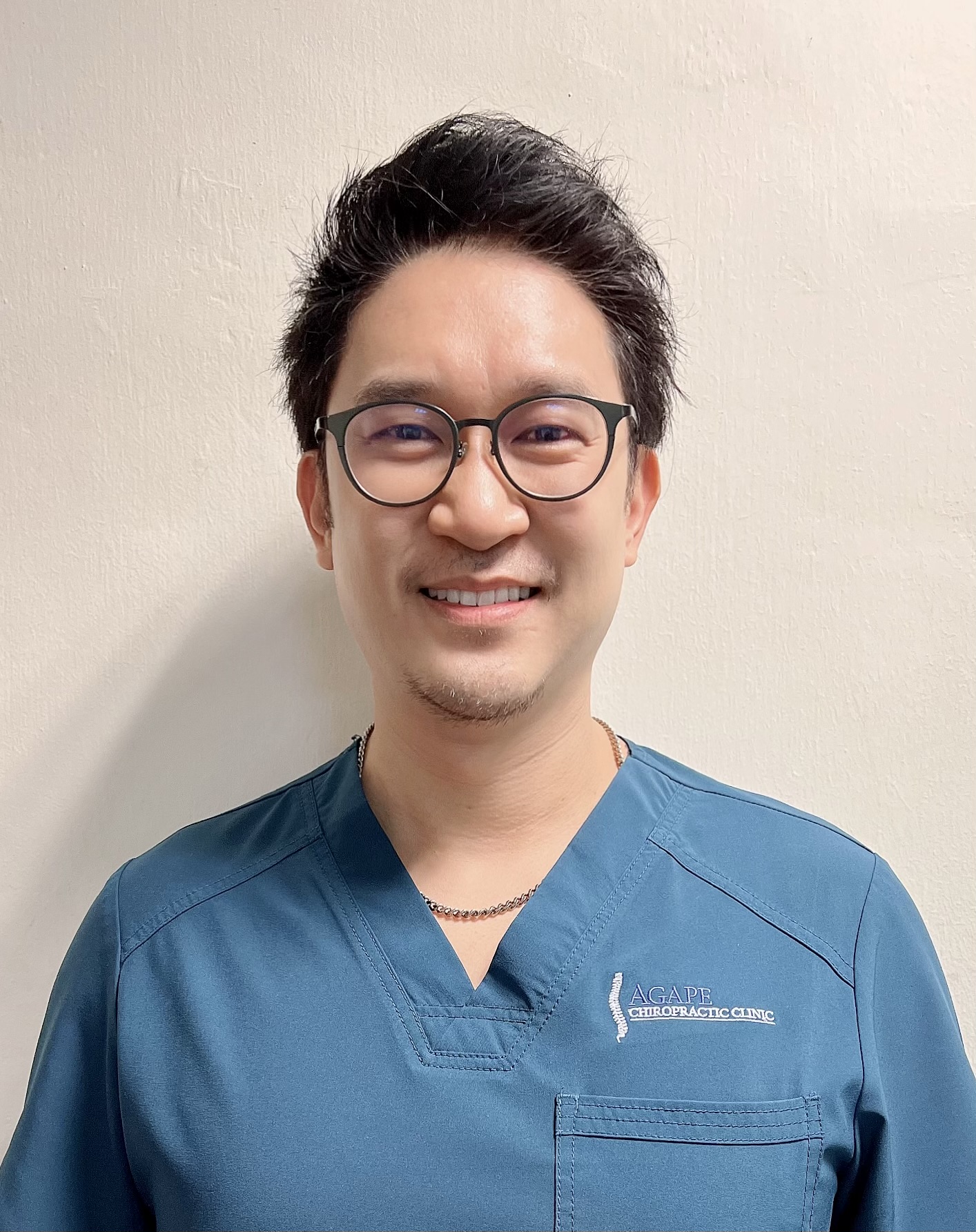
Dr. Luke Ho
Dr. Luke Ho obtained his Chiropractic degree from Palmer College of Chiropractic, Davenport, Iowa, USA in 2005. Prior to graduating, he worked in the campus clinic for 18 months as a clinical extern, treating students, faculty, and outpatients. In 2001 Dr. Ho obtained a BSc. in Sports Medicine from the University of Evansville, Indiana, USA. During his 3rd and 4th years there, he interned at the St. Mary’s Hospital Cardiac Rehabilitation Department, the St. Mary’s Sports and Fitness Center, and the University of Evansville Rehabilitation Center where he worked closely with the university tennis, volleyball, basketball and baseball teams.
Questions